

Knowledge & Applications / Kitchen planning
Plasclad knowledge guide · Published 21 October 2026
Commercial kitchen hygienic wall cladding: specification and cost guide
A commercial kitchen wall finish has to work around food preparation, washing, cleaning and a busy service. Hygienic PVC wall cladding can provide a practical, wipe-clean finish where the selected sheet and installation system suit the conditions. The best starting point is a wall-by-wall specification, rather than choosing on sheet price alone.
This guide helps restaurant owners, catering operators and fit-out contractors plan materials, installation and a complete project budget. For a quick range overview, see our commercial kitchen wall cladding page.
What does a hygienic kitchen wall need to do?
The Food Standards Agency's guidance for caterers says food preparation walls should be kept sound and be easy to clean and, where necessary, disinfect. It describes smooth, hard-wearing, washable surfaces in good repair.
Specify the whole installed finish: sheets, joints, corners, penetrations and junctions with worktops and other surfaces. A hygienic product name does not establish that a kitchen meets every applicable requirement. Good detailing, maintenance and cleaning remain essential; antibacterial properties, where documented for a particular grade, do not replace them.
Choose the sheet for the location
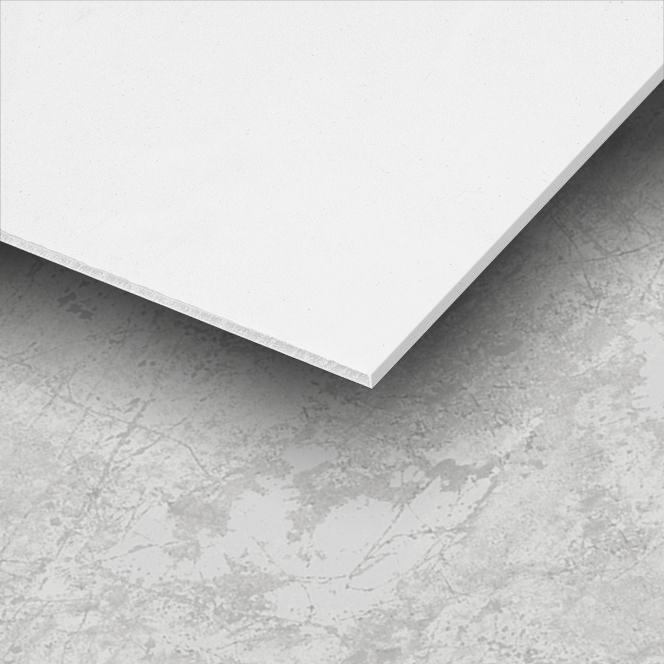
White satin range: product illustration. Confirm grade and finish with Plasclad before ordering.
Compare white satin hygienic sheets and white gloss sheets for a neutral finish. Where colour forms part of the design, explore coloured satin and coloured gloss. Confirm the precise grade, thickness, available dimensions and current product documentation before ordering.
- Preparation and service walls: consider cleaning frequency, trolley impacts, wall condition and exposed edges.
- Wash-up areas: confirm compatibility with moisture, cleaning chemicals and the proposed sealing details. Sheets alone do not make the entire wall assembly waterproof.
- Cooking areas: do not assume PVC is suitable behind ovens, fryers, grills or other heat sources. Provide equipment temperatures and clearances; a different, appropriately specified heat-resistant finish may be needed.
- Fire requirements: request the selected product's current fire classification and check its relevance to the proposed substrate and installation. Do not treat “fire-retardant” as a universal approval.
Thickness alone is not a complete specification. Ask about the substrate, fixing method, service temperature, chemical resistance and project requirements together.
How much does commercial kitchen wall cladding cost?
Build the budget from the complete installed system. Standard sheet prices are only one element; finish, grade, dimensions, fabrication, quantities and delivery can change the total. Check current selected-option prices and VAT treatment on the product page or written quotation.
- Sheets and an appropriate allowance for the cutting layout and unavoidable offcuts.
- Compatible adhesive, sealant, joint profiles, corners and edge trims.
- Preparation or repair of the existing wall and removal of unsuitable finishes.
- Measured cutting, holes, shapes and any agreed fabrication.
- Installer labour, access, delivery, waste disposal and kitchen downtime.
For an area comparison, divide the quoted sheet price by its width × height in metres to obtain a material-only £/m² figure. For example, a hypothetical £60 sheet covering 3m² is £20/m² before trims, fixing products, waste and labour. This is an arithmetic illustration, not a Plasclad price or installed-cost estimate. Use the same VAT basis when comparing quotations.
Calculate rectangular cut-to-size panels or request a project quotation for shaped panels and a fuller specification.
Where cut-to-size cladding can help
Ordering to confirmed dimensions can reduce repetitive cutting on site and help organise the fitting sequence. It may reduce avoidable offcuts when the cutting layout is planned well. Savings depend on the design, measurement accuracy and installer workflow; some site adjustment may still be needed.
Use the cost calculator for the rectangular panel options it offers. For holes, shapes, corners or other fabrication, send a dimensioned drawing and agree the scope with Plasclad. Read about ready-to-install fabrication and cut-to-size hygienic cladding.
Plan the installation before ordering
- Measure each wall and record doors, windows, sockets, pipes and equipment. Confirm units, orientation and finished dimensions.
- Check the substrate is sound and suitable for the chosen system. Resolve damp, loose finishes and uneven areas before fitting.
- Plan panel joints and movement allowances to the supplier's instructions. Do not assume a fixed gap suits every grade and temperature.
- Select compatible corner trims, division trims and edge trims, plus the recommended adhesive and sealant.
- Allow the specified preparation, acclimatisation and curing time before bringing the area back into use. Follow the installation guide and product instructions.
Cleaning and maintenance
Agree cleaning products, dilution, contact time and temperature with the material supplier. Avoid assuming every chemical, abrasive pad or pressure-washing method is suitable. Inspect seals, joints and damaged areas regularly and repair defects that could make cleaning harder.
Frequently asked questions
Can cladding be fitted over existing tiles?
It may be possible where the tiles and underlying wall are sound, securely bonded and suitable for the fixing system. Have the substrate assessed and confirm preparation and adhesive requirements first. Covering loose tiles or unresolved damp is not a repair.
Will cladding guarantee a food hygiene rating?
No. The condition of the premises is only part of a wider assessment. Material selection, installation, maintenance and food-safety management all matter.
What should I send for an accurate quote?
Provide wall dimensions or drawings, quantities, finish and grade preferences, substrate details, heat sources, cleaning regime, required fire specification, postcode and target fitting date. Mark holes, corners and shaped cuts clearly.
Plan your kitchen project with Plasclad
Send your drawings and request a quotation, call 01922 490266 or email hello@plasclad.co.uk. We can discuss sheet selection, cut-to-size options and the information needed for your order.
Browse sheets, trims and fixing products · Use the cut-to-size calculator · Back to Knowledge & Applications